Guide
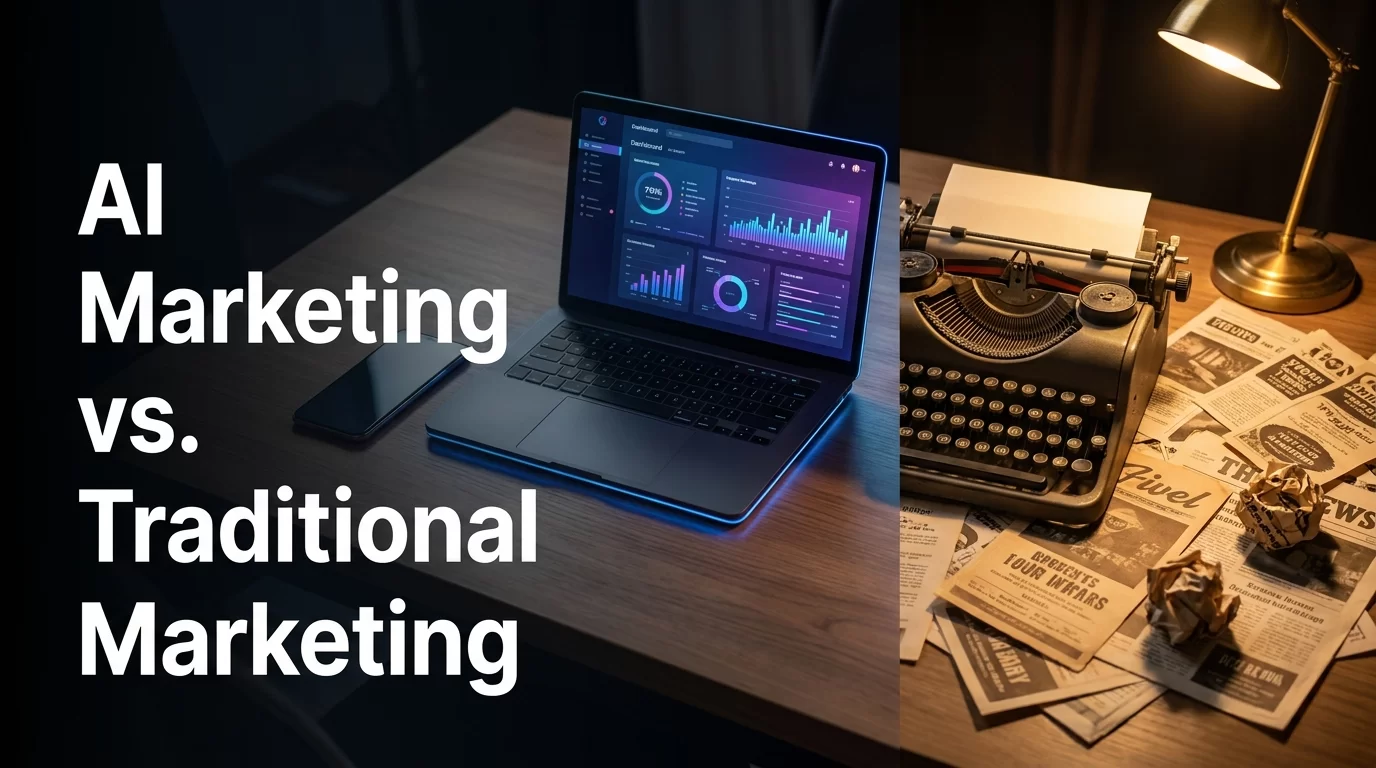
AI Marketing vs. Traditional Marketing: What Is the Difference?
By the Limitless Solutions Team · Last updated October 30, 2026
Quick answer: AI marketing uses artificial intelligence to handle repetitive work like content, lead response, and follow-up in seconds and around the clock, while traditional marketing relies on people doing each task by hand. AI wins on speed, cost, and consistency. Humans still win on strategy, creativity, and relationships, which is why the best results come from combining the two.
Neither approach is automatically better, but for most local businesses one is a much clearer fit. Here is a plain-language comparison so you can decide what makes sense for you.
What Is AI Marketing?
AI marketing uses artificial intelligence to plan, create, and run marketing tasks. That includes generating content, optimizing ads, responding to leads instantly, answering calls, and automating follow-up. The AI handles volume and speed, while a human team sets the strategy, protects the brand voice, and makes the creative and judgment calls. It is less a replacement for marketers and more a force multiplier that lets a small team do the work of a much larger one.
In practice, AI marketing means your content keeps going out even when you are slammed, your leads get a response in seconds instead of hours, and your follow-up never gets forgotten. The systems run in the background, and the people focus on the decisions that actually move the needle for your business.
What Is Traditional Marketing?
Traditional marketing is the hands-on approach most agencies have used for years. A person writes each social post, designs each ad, and follows up with each lead manually. It can absolutely produce great work, and for certain high-touch, creative campaigns, that human craftsmanship is exactly what you want.
You will also hear “traditional marketing” used to mean offline channels like print ads, radio, billboards, and direct mail. Those still have a place, especially for local name recognition, but most buying journeys now start online. Pew Research Center found in 2025 that 84 percent of U.S. adults use YouTube and 71 percent use Facebook (Pew Research Center, 2025), so even businesses that invest in offline marketing need a strong, fast-moving online presence to catch the customers it sends their way.
The trade-off is that it is slower and more expensive, and response times suffer whenever the team is busy or off the clock. When everything depends on a person being available, the gaps show up at the worst times, like evenings and weekends, when a lot of buying decisions actually happen. That is not a knock on the people involved. It is simply a limit of doing everything by hand.
AI Marketing vs. Traditional Marketing: The Key Differences
When you put the two side by side, a few differences stand out, and they are the ones that tend to matter most for a local business trying to win more customers.
| Factor | AI marketing | Traditional marketing |
|---|---|---|
| Lead response | Seconds, any time of day | Hours or days, during business hours |
| Cost | Lower, because repetitive work is automated | Higher, because every task takes paid labor time |
| Availability | 24/7, including nights and weekends | Business hours |
| Consistency | Content and follow-up keep running in busy seasons | Slows down when the team is busy |
| Personalization | Tailored messages at scale | Personal, but limited by time |
| Strategy and creativity | Led by people | Led by people |
Notice that the last row is a tie. AI is not better at everything. It is better at volume, speed, and repetition. Strategy, creativity, taste, and relationships are still firmly human territory, which is why the strongest setups do not try to pick one over the other.
Which Is Better for Local Businesses?
For most local, service-based businesses, an approach that leads with AI wins on the metrics that drive revenue: faster lead response, consistent visibility, and lower cost. The businesses that struggle are usually the ones still doing everything by hand, missing calls and following up slowly while a more responsive competitor scoops up the customer.
Picture a homeowner with a leaking water heater who fills out three contact forms at 8:30 on a Sunday night. The company with an AI system texts back within a minute, answers a couple of questions, and books a Monday morning visit. The other two companies see the form on Monday at 10 a.m. By then, the job is already gone. That single moment is the whole difference between the two approaches.
That said, the goal is not to remove people from the picture. It is to let AI handle the speed and volume so your team, or your agency, can focus on strategy and customers. A local contractor, chiropractic office, or real estate agent does not need a giant creative department. It needs to be found, to answer every call, and to follow up reliably, and that is exactly the work AI is built to carry. If you are weighing the budget side, our guide to AI marketing agency costs breaks down real price ranges.
Can You Combine AI and Traditional Marketing?
Yes, and the best results usually come from combining them rather than choosing a side. AI handles the repetitive, time-sensitive work like content production, instant lead response, and follow-up, while experienced humans handle strategy, brand voice, and the relationships that close bigger deals. You get the speed and affordability of automation and the judgment and creativity of real marketers.
That is exactly how we work at Limitless Solutions. We use AI for speed and scale and put people in charge of strategy and quality, so you are not stuck choosing between cheap-and-generic or expensive-and-slow. For most local businesses, that blend is the sweet spot, and it is a big part of why the AI-led model keeps winning.
Frequently Asked Questions
Not entirely. It is changing how the work gets done. The agencies thriving today are the ones using AI to deliver faster, more affordable results while keeping human strategy in the loop.
Not when it is done right. AI handles volume and speed while humans review and guide the output, so quality stays high and consistency actually improves.
AI marketing is usually more affordable because it automates the repetitive work that makes traditional marketing so labor-intensive. Many local businesses get a full AI-powered system for $500 to $1,500 per month.
It can be for local name recognition, especially with an older audience. Just make sure your online presence is ready to catch the people those ads send your way, since most will look you up online before they call.
Start with the biggest leak. For most businesses that is slow lead follow-up or missed calls. Automate that first, then add consistent AI-assisted content once the follow-up is running smoothly.
Get the Best of Both With Limitless Solutions
Book a free strategy call and see how we combine AI speed with human strategy for your business.
Keep Reading
How Much Should a Small Business Spend on Marketing?
How much should a small business spend on marketing? A common benchmark is 7 to 10 percent of revenue. Here is how…
Read the Guide
How Much Does an AI Marketing Agency Cost
How much does an AI marketing agency cost? Local agencies typically run $500 to $1,500 per month. Here is what drives pricing…
Read the Guide
AI Marketing for Small Businesses
AI marketing for small businesses, explained. Learn how small businesses use AI for content, calls, and follow-up, the benefits, and how to…
Read the Guide