Guide
AI Voice Agents for Small Business: How They Work
By the Limitless Solutions Team · Last updated October 30, 2026
Quick answer: An AI voice agent is software that answers your business phone, talks with callers in a natural voice, answers their questions, and books appointments into your calendar, 24 hours a day. For small businesses that lose customers to missed calls, it is one of the highest-return tools available today.
In this guide we explain how an AI voice agent works, what it can and cannot do, how to estimate what missed calls are costing you, and whether it is worth it for your business.
What Is an AI Voice Agent?
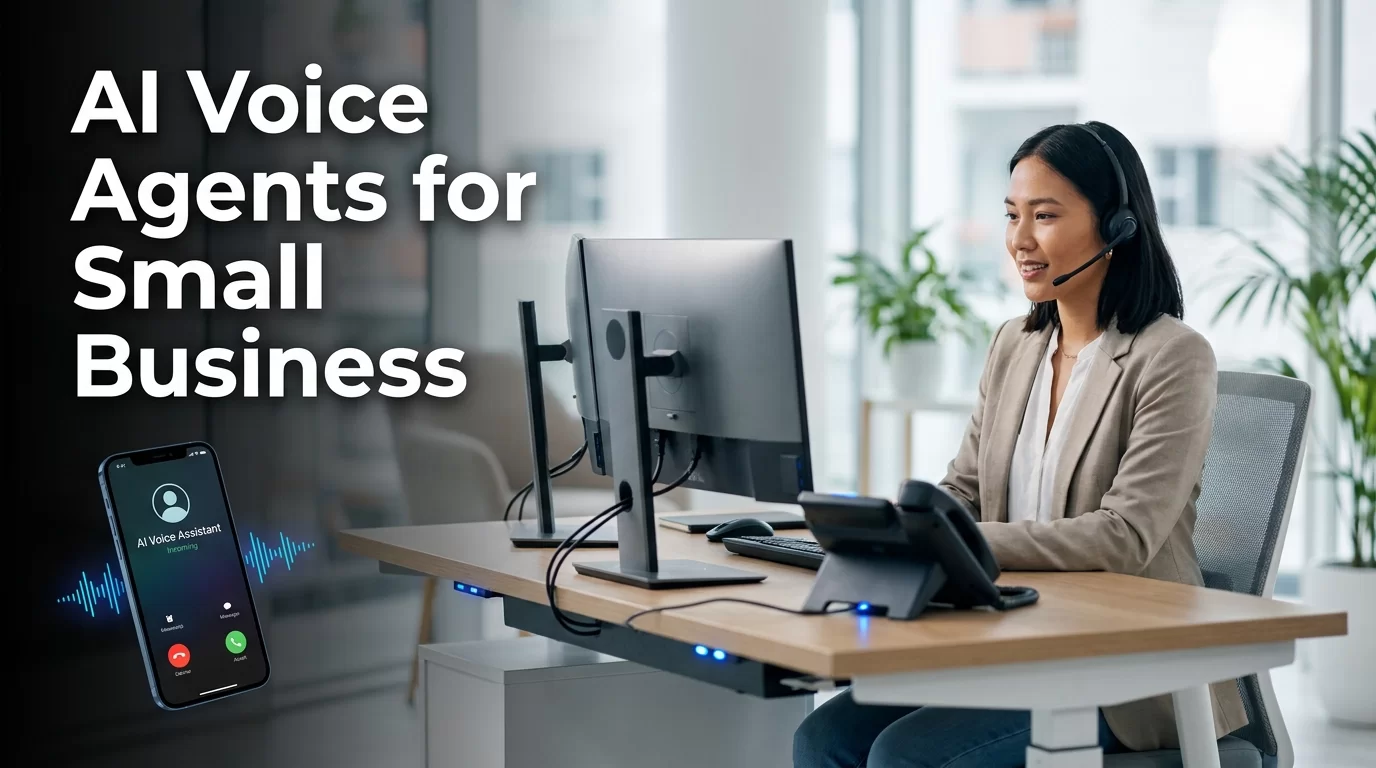
An AI voice agent is a virtual receptionist powered by artificial intelligence. It answers incoming calls in a natural-sounding voice, understands what the caller needs, answers common questions, collects their information, and books appointments directly into your calendar. Unlike a basic voicemail or a phone menu that frustrates people, it holds a real conversation and never gets tired, distracted, or stuck on another job.
The technology has come a long way in a short time. Today’s AI voice agents sound conversational rather than robotic, they understand natural speech instead of forcing callers through a list of numbered options, and they can be trained on the details of your specific business. For a caller, it feels like reaching a helpful front desk, except that front desk is available at midnight on a holiday just as easily as it is on a Tuesday afternoon.
How Do AI Voice Agents Work for Small Businesses?
The setup is simpler than most owners expect. When a call comes in and you cannot answer, it routes to the AI agent. The agent greets the caller, asks how it can help, and responds using information about your business, your services, your hours, and your booking rules. It can answer questions, capture the caller name and number, qualify the lead, and schedule the appointment. Everything is logged so you can follow up if you need to.
You stay in control of how it behaves. You decide the greeting, the tone, which questions it asks, and what happens with urgent calls. You can have it handle only the calls you miss, or answer everything after hours and on weekends. Once it is set up, it runs quietly in the background and simply stops letting calls fall through the cracks.
What Can an AI Voice Agent Do?
A well-built AI voice agent handles the tasks that usually cost small businesses customers. It answers every call, including after hours, weekends, and holidays, and greets callers by your business name using the script you approve. It answers common questions about your services, pricing, and hours, then asks the right questions to qualify the lead before booking the appointment straight into your calendar.
Behind the scenes, it captures each caller’s details and sends them to your CRM so you have a record of every conversation. And when a call is urgent, like a burst pipe or a patient in pain, it can flag the call and alert your team immediately instead of making the person wait.
The point is not to remove you from your business. It is to make sure that the moment someone is ready to become a customer, there is always something on the other end of the line ready to help them, even when you physically cannot be.
How Much Revenue Do Missed Calls Cost a Small Business?
More than most owners realize. Missed-call rates vary a lot by industry and by how busy your team is, so the most useful number is your own. Look at your phone log for the last 30 days and count the calls that went unanswered or to voicemail. Many callers who reach voicemail never leave a message. They simply call the next business on their list, and in service industries that next business often wins the customer for good.
Then do the quick math. If you miss five calls a week, half of those callers would have booked, and each new customer is worth $300, that is about $1,500 in lost revenue every month, or roughly $18,000 a year. Those are not cold leads you have to chase. They are people who wanted to give you money and could not reach you. Our free Missed Call Revenue Calculator runs this math for your business in under a minute.
Are AI Voice Agents Worth It for Small Businesses?
For any business that relies on phone calls to book work, yes. The cost is small compared to a single recovered job, and the agent works around the clock without breaks, sick days, or a salary. It also levels the playing field against larger competitors. When a customer calls at eight at night and your bigger competitor sends them to voicemail, your AI agent is the one booking the appointment.
That responsiveness is often the entire reason a customer chooses one business over another. People tend to hire whoever answers first and makes it easy to move forward. An AI voice agent makes sure that is you, consistently, without you having to be tied to your phone every waking hour. It is one of the clearest examples of AI quietly paying for itself.
AI voice agents come standard in our Elite package and are available as an add-on to any package. See our pricing →
Frequently Asked Questions
Modern AI voice agents sound natural and conversational. We configure the greeting and tone to match your brand, and the agent focuses on helping the caller quickly, which is what most people care about most. Many businesses choose to have the agent identify itself as a virtual assistant, which callers generally appreciate.
Yes. We set the agent to identify urgent situations, collect the key details, and alert your team right away so you can respond fast to the calls that cannot wait.
Absolutely. The AI agent handles the calls you would otherwise miss and routes the rest to you. You stay in control of the relationships that matter.
It depends on call volume and how much the agent needs to handle. At Limitless Solutions, an AI voice agent is included in our $1,500 per month Elite package and is available as an add-on to our other packages.
It can, but the rules are stricter. In 2024 the FCC ruled that AI-generated voices count as artificial voices under federal telemarketing law, so outbound AI calls generally require the person’s prior consent. Answering inbound calls from customers who call you does not raise the same issue.
Stop Losing Customers to Missed Calls
Book a free strategy call and we will show you how an AI voice agent would work for your business.
Keep Reading
Why Is My Business Not Showing Up on Google?
Why is your business not showing up on Google? Here are the most common reasons local businesses stay invisible, and how to…
Read the Guide
AI Marketing vs Traditional Marketing
AI marketing vs traditional marketing: what is the difference? Compare speed, cost, response time, and results, and see which fits local businesses.
Read the Guide
What Is Answer Engine Optimization (and Does Your Business Need It)?
What is answer engine optimization (AEO)? It is optimizing your content to be the answer AI and search engines give. Here is…
Read the Guide